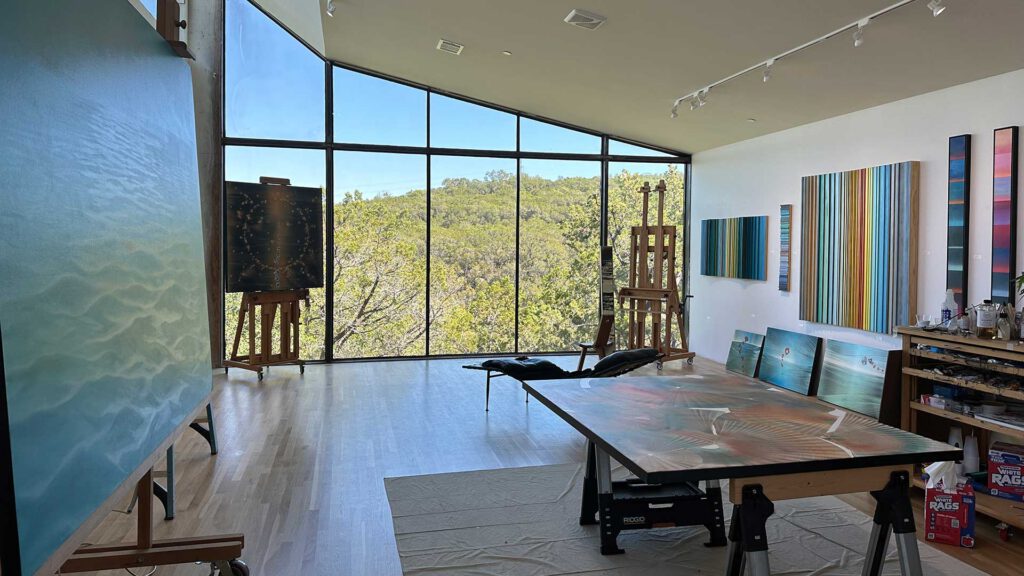
The best part of being an art consultant is when you can commission original art. One of my recent projects for a healthcare facility in Dallas allowed us to work with multiple regional artists, including some we had never worked with before. When a chance arose to meet with the artists in Austin to pick up their artwork on the way to the installation in Dallas, my coworker and I took it. So often, when working on projects, most of the communication is through phone calls and emails, and while that can help build a successful relationship on its own, there is something to be said for meeting in person. To be able to talk to the artists in their studio space and see where they create the artwork gives you a better sense of who they are. Luckily, on this trip, we could schedule time with three artists. Andrea Pramuk, who produces beautiful abstract artwork using alcohol ink and paint, showed us new items she has been working on – including wall covering artwork. Paul Stankiewicz welcomed us into his space and, equally as important, introduced us to his cat while he talked to us about how he came to live in Austin and showed us a few of his paintings representing famous landmarks in Texas. After meeting with Paul and Andrea, we took a surprisingly adventurous trek to Roi James’ studio, filled with hairpin turns and one-lane roads leading up to his 2-story house and studio, which Andrea jokingly calls his “fortress.” Roi is a new artist who works in multiple mediums, including unique dimensional works on woods that he refers to as his Construct Series. He showed us his workshop and the second-story studio with an entire glass wall overlooking the hill country. My journey through Austin to meet local artists while working on an art project for a women’s center in a hospital was an incredible experience. It emphasized the role of art as a source of healing, comfort, and inspiration, especially in places where it’s needed most. Getting to meet the artists responsible for these creations was a tremendous privilege I won’t forget!
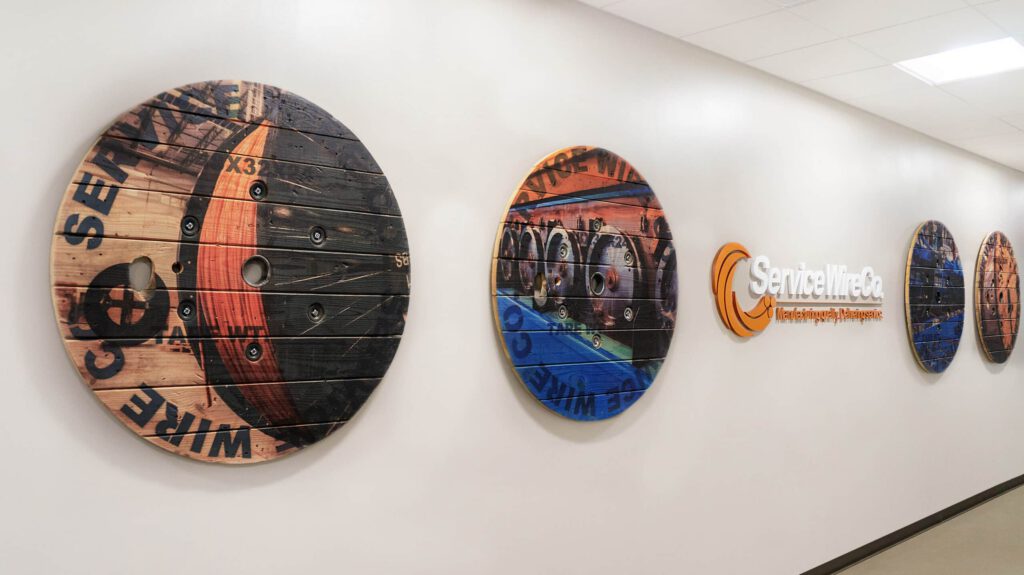
As an art consulting firm that specializes in the healthcare and corporate sectors, Skyline Art frequently receives requests to incorporate branding into our art packages. Custom branding is an excellent opportunity to create a memorable moment in any commercial setting. With the help of our art consultants, graphic designers, and production team, Skyline Art can create a unique and artful branding experience that leaves a lasting impression. The most successful brands engage their audience and differentiate themselves from their competitors. Through Skyline Art’s comprehensive design process, we work closely with our clients to devise a design that works cohesively with existing branding while constructing a beautiful original artwork. The step-by-step process begins with an initial meeting between the client and one of the Skyline Art consultants to review client objectives and branding materials, typically drawing inspiration from the current company mission, vision, and logo. Once the art consultant clearly understands what the client is looking for in their custom branding, the design process begins! During a brainstorming session between the Skyline Art consultants and graphic design teams, the consultant will provide an overview of the client directives and the conditions of the space where the piece will be installed (this could include anything from the dimensions of the walls to any existing outlets or signage to client timeline and budget). Once the need-to-know information has been noted, the team conceptualizes how the final product should look, what materials should be incorporated, and how it will be assembled. When considering existing conditions of the space, particularly in healthcare, the cleanability of the work is always an element of concern, and it is during these brainstorming sessions these concerns are addressed and discussed. Once the requirements are established, the Skyline Art graphic design team gets to work creating a variety of original designs for the client to choose from. Depending on what the client has envisioned, this can be an intensive process between the designer, consultant, and client, through which several design iterations are reviewed until a final version is selected. These designs are then sent to the client for assessment, after which the client and consultant will meet to review any questions or concerns the client may have or final tweaks they may like to make to the design. Once the final design has been approved, the consultant prepares to send the concept into production; it is through the production process that these ideas are realized, and the final product is created. Upon completing the bespoke branding, the client is notified, and a date for installation is scheduled. When a date has been selected, our consultants will coordinate the transportation and installation of the work to its destination. The Skyline Art installation team (Artful Installation), will arrive onsite and collaborate with the consultant on the best way to install the work, considering factors such as the height of the wall, any existing furniture that may be in the space, whether specialty hardware will be necessary, and any other extenuating factors that may come into play. Once our installation experts have installed the original branding element, our work is complete, and our client can enjoy their one-of-a-kind original branding artwork for many years to come.
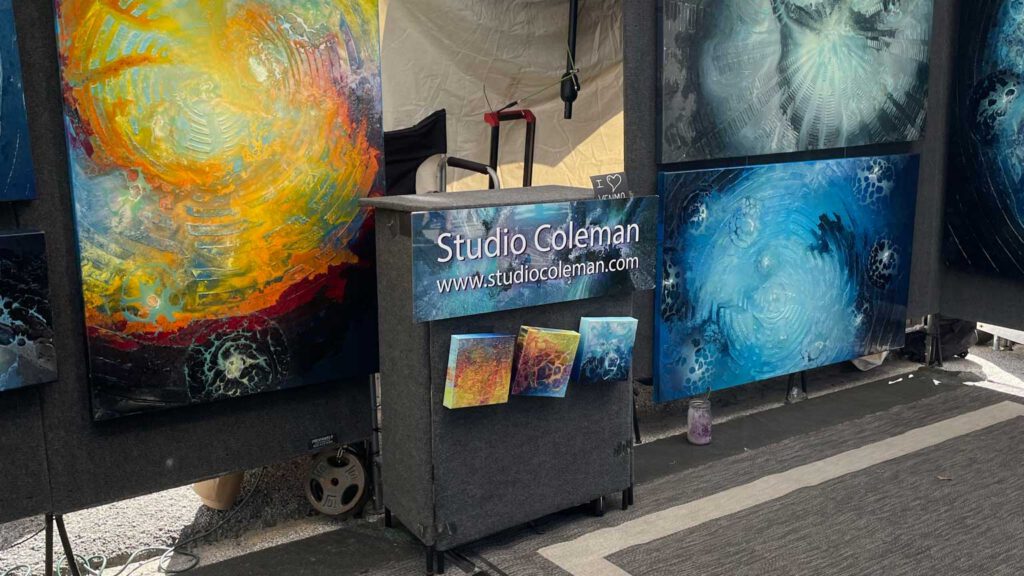
Every fall, artists from around the country migrate to Houston to participate in the downtown Bayou City Art Festival. This event showcases the works of 300 artists across 19 different media categories. This outdoor festival attracts more than 20,000 attendees, allowing visitors to meet with exhibiting artists, purchase one-of-a-kind art, and enjoy live music and tasty food.As an art consultant, I constantly seek new, talented artists to use in client spaces (Okay, or keep for myself!). This year, I searched for artists who use traditional mediums in unconventional ways, whether through recycled objects, reinterpretations of traditional mediums, or just a new perspective on a time-tested subject- and the festival did not disappoint! Here are just a few of the artists I had the pleasure of meeting at the festival: Gregory Arth We have had the incredible privilege of working with Greg on a few projects at Skyline Art. He coincidentally dropped off a commissioned piece to us on his way into town. The commission is a stunning rendition of the Golden Gate Bridge he created for a children’s hospital in California. My favorite part is that the piece is comprised of vintage circuit boards plus a little sheet music from our client’s archive! There were so many moments of discovery, which is perfect for positive distraction for the patients, visitors, and staff. Greg began using circuit boards as a medium for his art in 1989 after seeing a piece of tech that reminded him of an aerial view of NYC. His current work spans a wide range of subjects- from portraits and still lives to bustling cityscapes and robot fights. It’s always good to see a friend of Skyline at the fair! Jerry Bergin My next stop was at Jerry Bergin’s Booth. Jerry is an award-winning contemporary mixed media artist residing in Oklahoma, combining plasters, automotive finishes, and various glazes. His work displays a rugged textural quality that is still light, airy, and fresh. I love that Jerry’s work tiptoes the line between distressed and new. Often, a corporate or healthcare setting can feel cold and uninviting. However, adding artwork with a touch of earthiness can inject an inviting sense of warmth and comfort. My favorite piece, reminds me of reclaimed metal, with rich browns and blues accented by pops of vibrant yellow and orange. Neil Russell Greenridge Originally from Barbados, Neil Russell studied and worked in New York and Iowa before landing in Southern California. Utilizing multiple mediums, including heavy-bodied acrylics, tempered glass, metal, and resin, Neil hopes that every time viewers see his work, they notice something new. As you can see in the photos below, his mission is undoubtedly a success! I had a hard time choosing a favorite, but it’s a tie between this vast expanse of blue and the more cosmic piece beneath it. The natural wave-like element, coupled with the serene blue tones, would work wonders in livening up a space needing color. Conclusion Art festivals are an excellent platform that brings together artists from diverse backgrounds and regions, creating a space for creativity and innovation. They are also a great resource for finding new artists to add to the Skyline Art artist database. Upcoming festivals I look forward to attending are the Houston Art Fair (January 26th – 28th, 2024) and the Spring Bayou City Art Festival (March 23rd-24th, 2023).
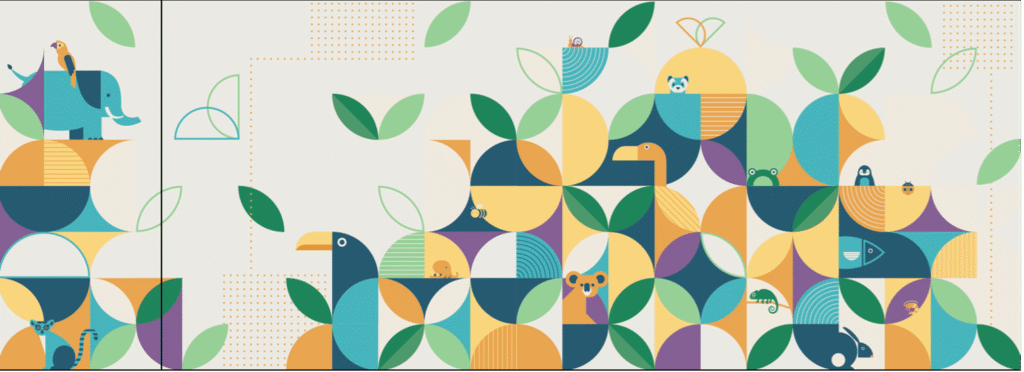
We have all sat in a doctor’s office waiting area or exam room bored out of our mind right? As adults, we typically entertain ourselves with activities like reading, people watching (which depending on where you are, can be very entertaining) or scrolling aimlessly through social media. But for children, sitting still can be a real challenge. Their minds race a mile a minute and the anticipation of waiting in a medical setting can make the experience even more unnerving. As art consultants how do we help the younger demographic, children who depend a lot on others to keep them entertained, navigate through the monotonous waiting that inevitably comes with a doctor’s visit? Seek-and-find art! What are the benefits of seek and find art and how do you effectively design / source this type of art? Let’s start with the benefits. Graphics that include a variety of elements keep the viewer engaged for longer periods of time making the waiting period feel shorter. This is probably the number one selling point with regards to seek and find art; imagery with a variety of elements provides an opportunity for the patient to find something new each visit. This keeps the art fresh and new each visit. There are also learning opportunities involved with “seek-and-find” art. For example, the pieces below are regional concepts showing animals native to their specific continents. Children can use the key to search and learn about a cool new animal! See what you can find! Interacting with the art can also be as simple as colors, shapes and counting. “What color is the bunny rabbit?” “How many leaves can you count?” “What shapes do you see?”. Any interaction is a positive to keep children entertained, calm and happy. To create a successful “seek and find” graphic there needs to be an element that draws the viewer to the piece. Bright colors, fun shapes or an interesting composition are all components that create interest within a piece. It could also be an image where the “seek-and-find” catches you by surprise. For example, artist Lisa Holley creates pieces where the primary subject, like the animal, reveals itself to be a collage of everything it eats. These details add an extra layer of interest and engagement. Curating an art collection that is inviting, interactive and engaging for all ages in a pediatric space is important to foster a positive healthcare experience. As a parent, I can attest that waiting for a doctor with a restless two-year-old can be quite challenging. Seeing the joy on my child’s face as they eagerly point out animals and learn new things from “seek-and-find” art is incredibly rewarding. From personal experience waiting for a doctor with a 2-year-old with no distractions is not fun. I get so much joy bringing home concepts and seeing Charlie light up with excitement to point out all the animals he can find. “Mommy look! A bird! An elephant! Mommy, what’s that? A lemur? He cuuuuute”. Seek and find art can turn a potentially stressful situation into a memorable and enriching one for both children and their families. It is a win-win for everyone involved.